
Life lessons through sports

“Sports are for fun, but they also offer benefits and lessons that carry over into all aspects of life”. This well-known anonymous quotation conveys the message that sport is the game which has some rules and custom. It is not only for fun and entertainment, but there are also some benefits of playing sports and which gives some important lessons for life. Every kind of physical sports is healthy because it involves running, jumping, stretching, mind skills and much more. There are so many sports available in the world nowadays, but we can categorize them by the numbers of players, the three main categories are individual sport, dual sport and team sport.
You can play these sports whenever you are free, or in school, it refreshes the person and gives him new energy through which the person performs well in his/her life. Other kind of sports is dual sports. It is played by two people at one time. For example: tennis, squash, ping pong, wrestling, car racing, board games, motorcycling, and many more. These games are good for all the people, but especially good for those people who are afraid of facing group of people during game and cannot perform well in sports with teams those kinds of person can choose dual sports in which only two person can play the game and through this that person can gain the potential playing with team and can build his confidence as well as personality. In addition, it also provides physical and mental strength to cope with team players. You can play these games with your friends in school or at home and in your leisure time. It keeps a person fresh and gives him/her peace of mind. The last category of sport is team sport. In which a group of people works together to help the team wins. https://www.youtube.com/watch?v=kE7D7qFayVg
History of Sports

Artifacts and structures suggest sport in China as early as 2000 BC.[15] Gymnastics appears to have been popular in China’s ancient past. Monuments to the Pharaohs indicate that a number of sports, including swimming and fishing, were well-developed and regulated several thousands of years ago in ancient Egypt.[16] Other Egyptian sports included javelin throwing, high jump, and wrestling. Ancient Persian sports such as the traditional Iranian martial art of Zourkhaneh had a close connection to warfare skills.[17] Among other sports that originated in ancient Persia are polo and jousting.
A wide range of sports were already established by the time of Ancient Greece and the military culture and the development of sport in Greece influenced one another considerably. Sport became such a prominent part of their culture that the Greeks created the Olympic Games, which in ancient times were held every four years in a small village in the Peloponnesus called Olympia.[18]
Sports have been increasingly organised and regulated from the time of the ancient Olympics up to the present century. Industrialisation has brought increased leisure time, letting people attend and follow spectator sports and participate in athletic activities. These trends continued with the advent of mass media and global communication. Professionalism became prevalent, further adding to the increase in sport’s popularity, as sports fans followed the exploits of professional athletes – all while enjoying the exercise and competition associated with amateur participation in sports. Since the turn of the 21st century, there has been increasing debate about whether transgender sportspersons should be able to participate in sport events that conform with their post-transition gender identity.[19]
Sports
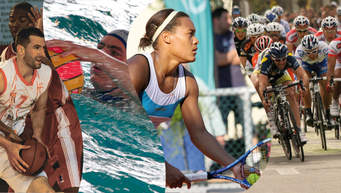
Sport includes all forms of competitive physical activity or games which,[1] through casual or organised participation, aim to use, maintain or improve physical ability and skills while providing enjoyment to participants, and in some cases, entertainment for spectators.[2] Hundreds of sports exist, from those between single contestants, through to those with hundreds of simultaneous participants, either in teams or competing as individuals. In certain sports such as racing, many contestants may compete, simultaneously or consecutively, with one winner; in others, the contest (a match) is between two sides, each attempting to exceed the other. Some sports allow a “tie” or “draw”, in which there is no single winner; others provide tie-breaking methods to ensure one winner and one loser. A number of contests may be arranged in a tournament producing a champion. Many sports leagues make an annual champion by arranging games in a regular sports season, followed in some cases by playoffs.
Sport is generally recognised as system of activities which are based in physical athleticism or physical dexterity, with the largest major competitions such as the Olympic Games admitting only sports meeting this definition,[3] and other organisations such as the Council of Europe using definitions precluding activities without a physical element from classification as sports.[2]However, a number of competitive, but non-physical, activities claim recognition as mind sports. The International Olympic Committee (through ARISF) recognises both chess and bridge as bona fide sports, and SportAccord, the international sports federation association, recognises five non-physical sports: bridge, chess, draughts (checkers), Go and xiangqi,[4][5] and limits the number of mind games which can be admitted as sports.[1]
Sport is usually governed by a set of rules or customs, which serve to ensure fair competition, and allow consistent adjudication of the winner. Winning can be determined by physical events such as scoring goals or crossing a line first. It can also be determined by judges who are scoring elements of the sporting performance, including objective or subjective measures such as technical performance or artistic impression.
Records of performance are often kept, and for popular sports, this information may be widely announced or reported in sport news. Sport is also a major source of entertainment for non-participants, with spectator sport drawing large crowds to sport venues, and reaching wider audiences through broadcasting. Sport betting is in some cases severely regulated, and in some cases is central to the sport.
 The Blog Of SHALU